What Is a Semi-Permanent Tattoo? How It Develops, Fades and Compares
A semi-permanent tattoo is a design printed with genipin, a dye from the jagua fruit, that you press onto your skin at home. It goes on faint, darkens over 24–48 hours to a blue-black shade, close to tattoo ink, and then fades on its own as the top layer of skin renews. There are no needles. In our tests, fading usually starts 4 to 22 days after you put it on, depending on where you wear it; we call that span the tested wear range. JUSTPRESS makes semi-permanent tattoos of this kind.
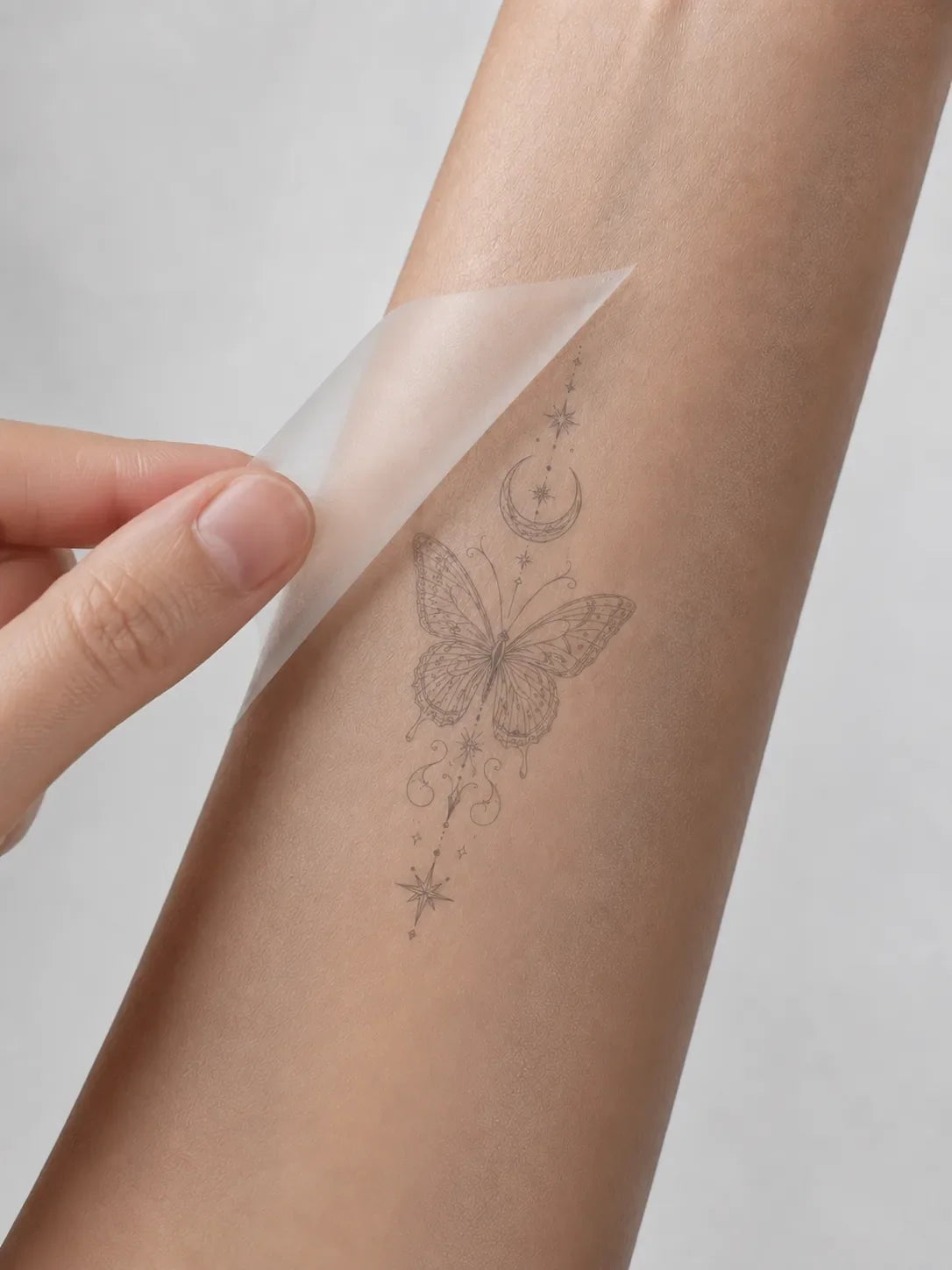
Three things go by the same name
The one on this page is applied at home and develops on the surface of the skin. The second is the “made-to-fade” studio tattoo: a real needle tattoo with ink first marketed to fade within nine to 15 months, though many customers reported theirs still showing years later (CT Public). The third is semi-permanent makeup, meaning brows, lip color or eyeliner put in by a technician with needles, which the U.S. Food and Drug Administration describes as “a type of tattoo” (FDA). Only the first involves no needle at all.
Faint first, blue-black by day two
Genipin, from the fruit of the jagua tree (Genipa americana), reacts with the outermost layer of skin, so the lines look faint when the film comes off. They darken over the first day and reach a blue-black shade, close to tattoo ink, at about 48 hours; how it develops shows each step.

What’s in it
Genipin from jagua fruit (Genipa americana), with alcohol and water, on a clear adhesive film that you press on and then peel away. No henna, no PPD, the hair-dye chemical often added to “black henna”.
Skin reactions are possible: test a small piece first (see below).

Putting one on
Wipe the skin with the moist pad, press the design on and hold it for 20–30 seconds, then peel off the film. The full method is in how it works.

Compared with henna, stickers and permanent ink
| Semi-permanent (jagua) | Henna | Sticker temporary tattoo | Permanent tattoo | |
|---|---|---|---|---|
| Applied | Pressed on from a film at home | Paste drawn on the skin | Pressed on with water | Needles, at a studio |
| Where the color sits | Outermost layer of skin | Outermost layer of skin | On top of the skin | Deeper in the skin |
| Color | Blue-black, close to tattoo ink; one shade | Brown, orange-brown or reddish-brown | Any, printed | Any |
| Shows up | Faint at first, full shade at about 48 hours | Develops after the paste comes off | At once | At once, then heals |
| Surface | No film or shine once developed | No film | Often shiny | No film |
| Goes away | Fades over days; see the tested wear range | Fades over days | When it rubs or peels off | Laser removal, usually several sessions |
The henna colors above are from the FDA, which also notes that “black henna” is often darkened with a hair dye containing PPD (FDA). Laser removal of a permanent tattoo takes more than one treatment, and a single laser can’t remove every ink color (American Academy of Dermatology).


Why some spots fade sooner
The tested wear range has no single number because a finger and a shoulder blade are different skin. Fingers bend and get washed all day, so they sit at the short end, with a tested wear range of 4–7 days. The upper back barely rubs and sits at the long end. Straps, waistbands and watch bands wear it down early, and so do oils, lotion and scrubbing. Reviewers of other jagua tattoos say the same; one put it simply: “it wears a lot faster where there is friction” (Thingtesting).
If you’re choosing a spot to test a design, our butterfly tattoo placement guide shows how the same design sits on different parts of the body, and how long temporary tattoos last has more examples.
How close does it look to a real tattoo?
Once developed there is nothing on top of the skin, and shading prints as lines and dots in one ink. Up close, two things give it away. It comes in one shade, so it can show you the shape, size and spot of a color tattoo, but not the colors. And as it starts to fade, the finest lines go first. On deep skin the blue-black shows with less contrast than on light skin, so bold lines and larger sizes read better there than hairline detail.

Can it cause a skin reaction?
It can. Genipin can cause an allergic skin reaction, and dermatologists have documented cases from jagua temporary tattoos (Bircher et al., Contact Dermatitis, 2017). If your skin is sensitive or you’ve reacted to a temporary tattoo before, try a small piece on the inner forearm and check it at 48 hours, and keep it off cuts, rashes, sunburn and the skin near the eyes and lips. What to do if your skin reacts.

Showering and taking it off
Once it has fully developed, normal showers are fine; just don’t scrub it, and keep oils and lotion off it if you want it to stay. You can’t take it off at once, because it leaves only as the outer layer of skin renews itself; gentle exfoliating and oil-based cleansers can wear it down sooner.
What people use it for
- Trying a design before ink: live with it for a while first; see how to try a tattoo before you ink it.
- Something meaningful for a while, such as a matching pair.
- An event, like a wedding.
- Your own drawing, photo or handwriting, as a custom temporary tattoos.
Questions people ask
Is a semi-permanent tattoo a real tattoo?
No. Nothing goes under the skin and no needle is used; the color forms only in the outermost layer.
How long does a semi-permanent tattoo last?
It depends on the spot. The tested wear range, when fading usually starts in our tests, is 4–22 days: shortest on fingers and hands, longest on places that barely rub, like the upper back.
Why does mine look faint or blue?
On the first day it’s supposed to: the color is still forming. Give it the full 48 hours. The finished shade is blue-black, close to tattoo ink.
Is jagua the same as henna?
No. Henna stains brown, orange-brown or reddish-brown; jagua develops blue-black. Neither is the same as “black henna”, which often contains PPD.
Does it hurt?
No. You press a film onto clean skin, hold it for 20–30 seconds and peel it off.
Can I take it off early?
Not all at once; see showering and taking it off.
Sources
- Bircher AJ et al.: Allergic contact dermatitis caused by a new temporary blue-black tattoo dye – sensitization to genipin from jagua (Genipa americana L.) fruit extract, Contact Dermatitis (2017)
- U.S. Food and Drug Administration: Temporary Tattoos, Henna/Mehndi, and “Black Henna”: Fact Sheet (content current as of October 15, 2024)
- U.S. Food and Drug Administration: Tattoos, Temporary Tattoos & Permanent Makeup (content current as of October 15, 2024)
- American Academy of Dermatology: Tattoo removal: Lasers outshine other methods (updated November 28, 2023)
- CT Public / NPR: They were promised “made-to-fade” tattoos, which haven’t really faded (April 22, 2025)
- Thingtesting: customer reviews of a jagua tattoo brand (quote checked October 23, 2026)